Discuss philosophy, religion, history, and other human subjects. This section is for theoretical, academic work and it is discouraged to talk too much about current events.
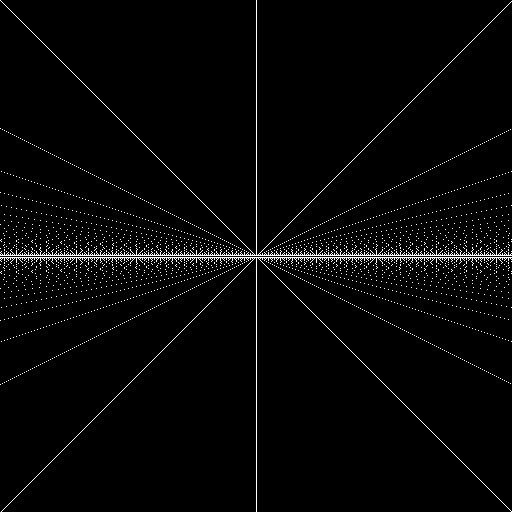
Also there are a lot of these cool number visualizations. Most recently I came across this one. The math and code website is pretty cool but I couldn't find the algebraic numbers picture on it. https://blogs.ams.org/visualinsight/201 ... c-numbers/
Also there are a lot of these cool number visualizations. Most recently I came across this one. The math and code website is pretty cool but I couldn't find the algebraic numbers picture on it.
Thank you, that's such an awesome visualization. I found that even just plotting random 2D functions can be very beautiful, for example these are some that I've once made:
Also there are a lot of these cool number visualizations. Most recently I came across this one. The math and code website is pretty cool but I couldn't find the algebraic numbers picture on it.
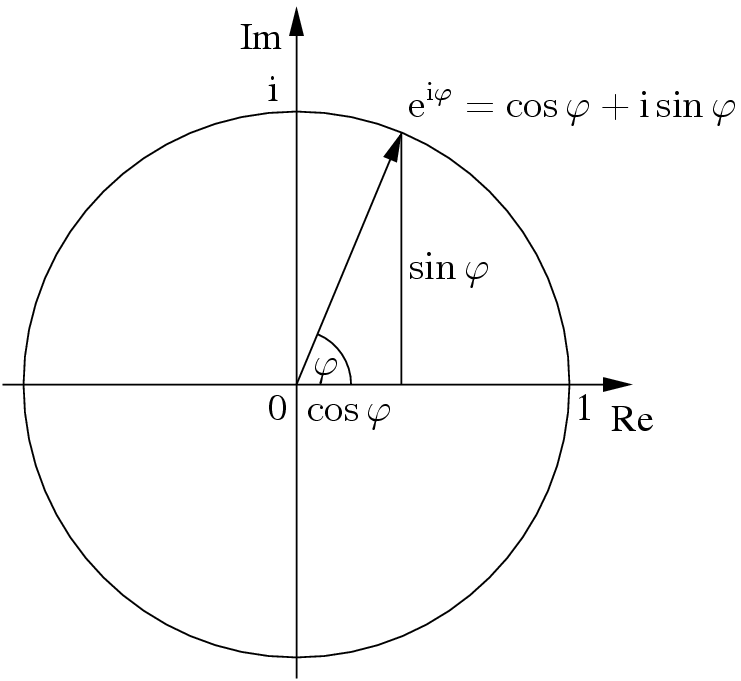
3. I'm really a newbie so I only know elementary Mathematics, but I really like the very simple geometric proof of Thales' Circle Theorem and De Moivre's Formula/Euler's Formula connecting the Complex Numbers and Trigonometry. The algebraic/geometric proofs relating to Trigonometry in general are some of the most accessible pieces of Mathematics, and thus enjoyable can be enjoyed by most people who have atleast some understanding of Highschool Mathematics (or earlier levels depending on your education system).
Speaking of this, I like how Euler dealt with this on his book:
cos^2 + sin^2 = 1
[cos(t) + i sin(t)] * [cos(t) - i sin(t)] = 1
[cos(t) + i sin(t)] * [cos(-t) + i sin(-t)] = 1
exp(it) * exp(-it) = 1
>What do you like about Mathematics?
Symmetry, Conservation, Correspondence
Divinity.
>Who are some of your favourite Mathematicians?
Pythagoras
>What are some of your favourite pieces of Mathematics?
There are uncountably many.
But recently, I'm quite attracted to Musical Set Theory. Because of Pythagoreanism. If you like finite groups, you would like this too.
Maybe this post of mine could be a nice introduction.
One of the things I'm interested in getting some level of understanding in the future as I do my studies is Algebraic Geometry, since it comes up or gets mentioned so often from the maths spaces I've lurked on online.
Take a look at Richard Southwell’s Foundations of projective geometry playlist. I think you are best off learning some basics of projective geometry to get a better intuition for algebraic geometry, then eventually you can work up to Matthew Morrow’s “Algebraic K-theory and its current role in arithmetic geometry.”
Does anybody here have any books they'd recommend about the history of mathematics for relative beginners/laypersons? I've honestly never been very attracted to mathematics even though I can respect it a lot, but the history and development of it has piqued my interest before. Documentaries/videos/online texts and whatever else are welcome as well!
Does anybody here have any books they'd recommend about the history of mathematics for relative beginners/laypersons? I've honestly never been very attracted to mathematics even though I can respect it a lot, but the history and development of it has piqued my interest before. Documentaries/videos/online texts and whatever else are welcome as well!
If you want something modern, I guess directly reading some of Euler's works like Elements of Algebra would be good. The book even starts with what numbers are.
But if you are looking for something very introductory, I can tentatively recommend Snezana Lawrence, A Little History of Mathematics (Yale University Press, 2025). I would just also point you to this blog post for an evaluation of the book and its shortcomings.
Here is a good blog post with more recommendations of a slightly more academic nature.
>What are some of your favourite pieces of Mathematics?
Mainly the discrete/logical side (I wish I knew more about analysis and calculus); set theory, graph theory, mathematical logic at large, formal language theory, etc. Most of my knowledge about it exists to the extent that it is pertinent to the field of linguistics, and a very good bit of it is, especially in the modern day with the distributional semantics-based embedding systems in modern AI allowing for continuous vector representations of meaning. I think linear algebra will only grow to be more important as a skill for linguists, as well as information theory (unless you consider that a branch of CS).