>What do you like about Mathematics?
Mathematics to me is the ultimate intellectual endeavor, like the mount Everest of thinking where we climb the mountain of abstraction to heights that disconnect us from the real world and we reach something like the "outer space" of thinking, an alien world that can be as mysterious as planets in distant galaxies. I do also find comfort in the clarity and no space for opinions to fight over, something either holds or it doesn't -- it's like a world with a language that cannot be misunderstood, unlike our natural human language that's extremely fuzzy and constantly changing. Mainly I love the freedom and "minimalism" however, the fact that it's something that cannot be taken away from anyone, that all this beauty and exploration of the vast mathematical landscape can only be done with pure thought with no equipment needed. It is one of very few certainties in this world I can hold on to. To put it in very lame terms: it is like an infinite number of video games for me to play anywhere that cannot be owned or fucked up by any corporation

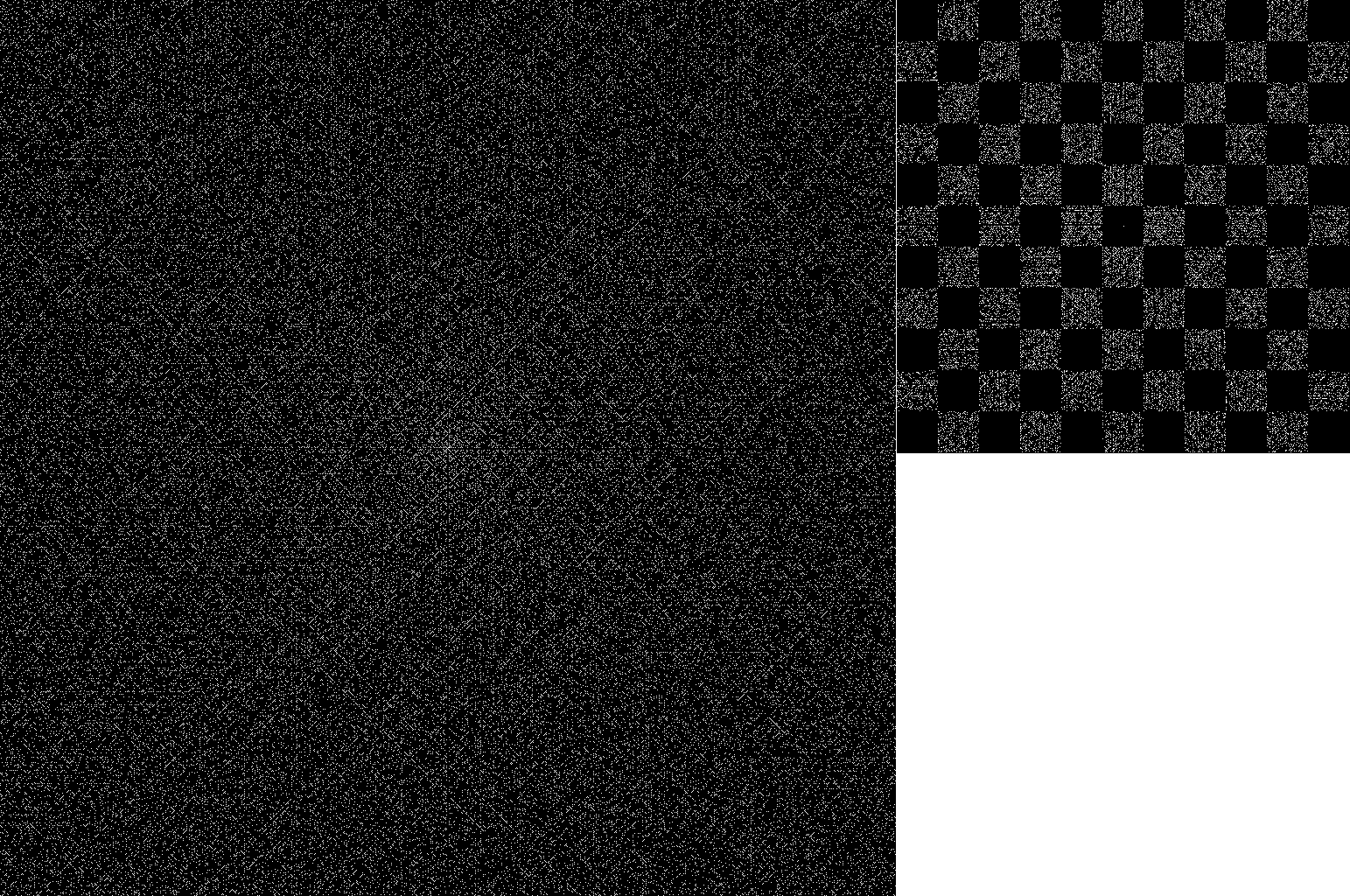
Also there is the aesthetic beauty that's very apparent when you start programming, and doubly so if you're doing something like computer graphics, shaders, fractals, procedural textures, bytebeat and all this kind of stuff. I totally understand how people hate math when all they remember is the struggle to memorize the formula for solving a quadratic equation without knowing what the fuck it's even useful for, but once you see the utility (which programming is excellent for), you just cannot but fall in love with it.
>Who are some of your favourite Mathematicians?
I never really thought about this much, but maybe I'd highlight Perelman. Of course there have been quite a few great minds in history, but among them it's still rare to find some who also so strongly held on to their principles and moral beliefs with their actions.
>What are some of your favourite pieces of Mathematics?
I think stuff about computability. I remember a small brain implosion moment when my uni prof told us that a complement of a formal language can be computationally simpler than the original, i.e. that a computer may be literally theoretically unable to recognize exactly which words belong to a certain language (i.e. follow a certain pattern), BUT it may very well be able to tell exactly which ones are NOT in that language. It is as if you were being shown random animals and you weren't smart enough to reliably tell "this is a bird", but you'd ALWAYS be able to reliably tell "this is NOT a bird".
----------------
That said I was surprised about how many people here, being mostly into philosophy, are actually into math too. I wonder why this is and would love to hear your opinions. My initial guess is that all these intellectual disciplines actually meet when you follow the road long enough, as if "all roads lead to Rome", with Rome here being the edge of knowability. We know for certain that some theorems in math are unprovable, some function uncomputable and a lot is simply beyond our comprehension, and philosophy (epistemology?) knows this too, so these disciplines meet at this point coming from different directions. I think it's no coincidence that physicists are now all discussing "interpretations" of quantum theories and basically get into metaphysics, I think they arrived at the same spot. I would like to ask the philosophers here: is this how you arrived to mathematics? Like I said I'm a noob at philosophy, as a programmer I came from the math side but think I am now seeing I might naturally continue down the philosophy road as well.